





Oragadam’s Next Competitive Battle Will Not Be For Factories. It Will Be For People.
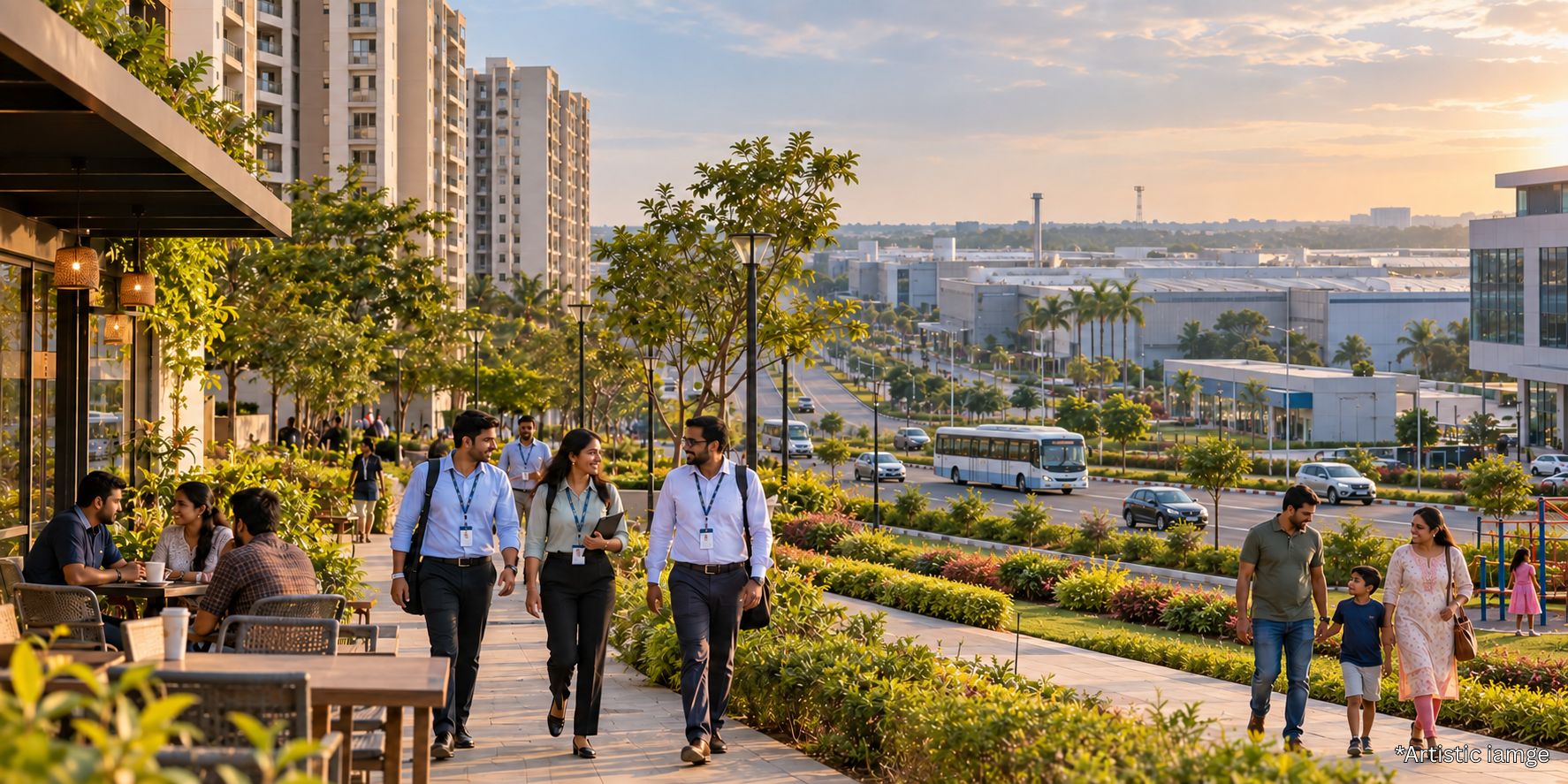
A decade ago, an industrial corridor could compete largely on land, power, roads, approvals and labour availability.
The factories of the future will demand something more difficult.
Talent.
Advanced manufacturing changes the workforce equation.
As automation increases and industries become more sophisticated, companies require engineers, programmers, designers, researchers, quality specialists, supply-chain experts and experienced managers alongside production teams.
Oragadam and Sriperumbudur are already moving in this direction.
Samsung's description of its Sriperumbudur ecosystem emphasises supplier capability, manufacturing knowledge and continuously improving standards. New aerospace and semiconductor-related capabilities are emerging elsewhere in the corridor. Daimler's latest proposed investment includes R&D and product development as well as manufacturing.
These are talent-intensive activities.
And talent has choices.
A highly trained engineer may decide between Chennai, Bengaluru, Hyderabad, Pune or an overseas opportunity.
A plant head relocating with a family will consider schools.
A multinational executive will consider housing quality.
A researcher will consider commute time and lifestyle.
A working couple will ask whether both careers can function from the location.
This means housing and social infrastructure are no longer separate from industrial policy.
They are part of industrial competitiveness.
Tamil Nadu has already acknowledged one end of this equation through large-scale worker accommodation at Vallam Vadagal, where SIPCOT developed housing capable of accommodating 18,720 women employees.
The next challenge is broader.
What does the region offer a senior engineer?
A plant CEO?
A young family?
An expatriate manager?
A specialist relocating from Bengaluru?
A researcher spending five years on an advanced manufacturing programme?
Quality residential development will matter.
So will schools.
Healthcare.
Restaurants.
Sports facilities.
Shopping.
Hospitality.
And spaces where professionals can build lives rather than merely complete shifts.
This may ultimately determine the next stage of Oragadam's evolution.
Capital can build factories surprisingly quickly.
Building a desirable human ecosystem takes much longer.
The regions that understand this early possess an advantage.
The future industrial competition between Indian states and cities will therefore not only ask:
"Where should we locate our next plant?"
It will increasingly ask:
"Where will our best people actually want tolive?"
Oragadam has already won enormous credibility as a manufacturing destination.
Its next opportunity is to become equally credible as a destination for the people driving that manufacturing revolution.