





The Chennai Peripheral Ring Road could change how we think about Oragadam.
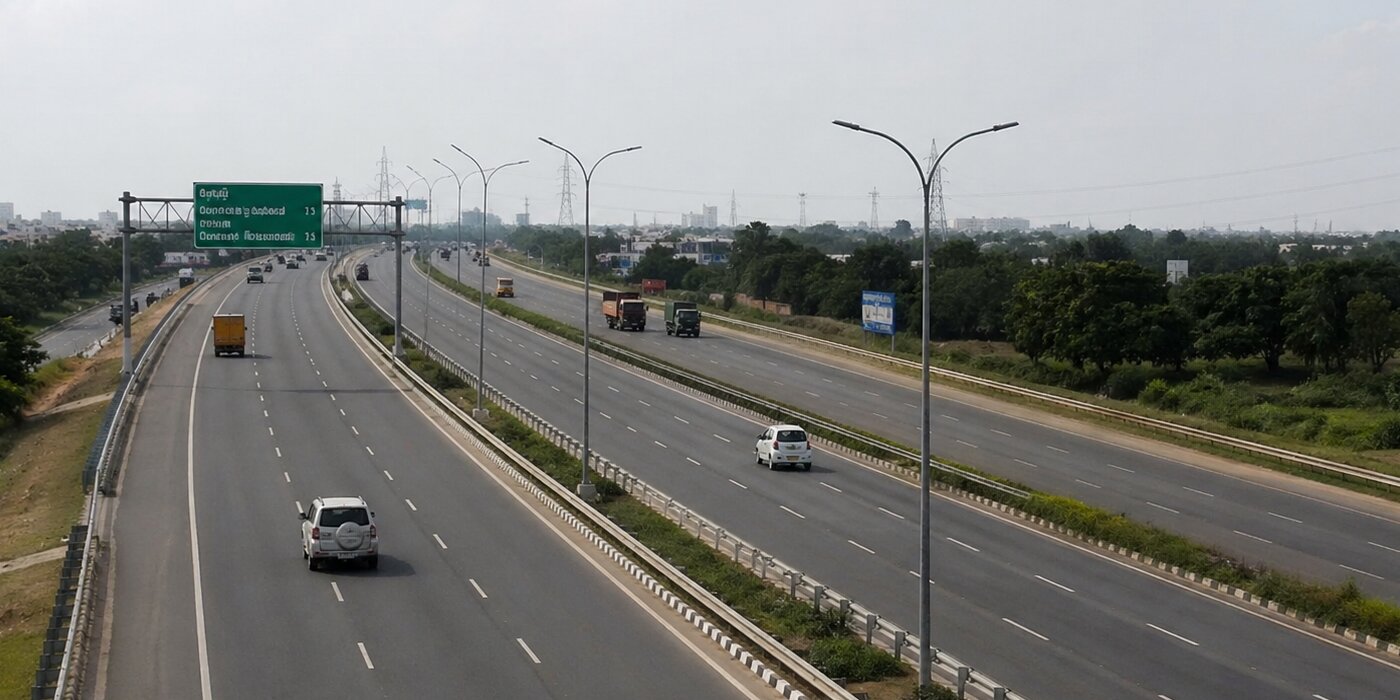
Infrastructure changes a location twice.
First physically.
Then psychologically.
The physical impact is obvious: roads improve movement.
The psychological impact can be even more important: places that once felt distant suddenly begin to feel connected.
The Chennai Peripheral Ring Road could have precisely that effect on the wider Oragadam–Sriperumbudur region.
The CPRR is planned as a roughly 133-kilometre peripheral corridor connecting major highways, industrial nodes and port-linked routes around the Chennai metropolitan region. Sections being financed through the Asian Infrastructure Investment Bank include 56.2 kilometres of six-lane dualcarriage way accompanied by service roads.
For an industrial economy, this is not merely a commuting project.
It is logistics infrastructure.
Manufacturing depends upon movement.
Raw materials must arrive.
Components must travel between suppliers.
Finished products must reach distribution centres, highways and ports.
Heavy vehicles need predictable routes.
Every reduction in uncertainty makes an industrial location more competitive.
Oragadam already possesses industrial gravity.
Improved peripheral connectivity can allow that gravity to interact more efficiently with Sriperumbudur, GST Road, southern Chennai, port-linked routes and other industrial nodes.
But there is another potential beneficiary: housing
Residential markets are heavily influenced by perceived travel time.
A location can be geographically close and psychologically distant if the journey is difficult.
Conversely, major road infrastructure can completely redraw how buyers understand a city.
Chennai has seen this before.
Old Mahabalipuram Road was once considered far.
So were large parts of the GST corridor.
As employment and infrastructure improved, perceptions changed.
Residential development followed.
Oragadam could experience a similar recalibration.
Importantly, infrastructure projects of this scale should not be treated as overnight transformation stories. Different CPRR sections have different construction and land-acquisition timelines, and benefits will emerge progressively rather than simultaneously.
But the direction is significant.
Chennai is planning for a metropolitan future that is far more distributed than its past.
Employment will not sit in one central business district.
Manufacturing will not remain disconnected from housing.
Ports, industrial parks, residential areas and logistics corridors will increasingly form part of one larger regional network.
In that new geography, Oragadam's location begins to look different.
It stops appearing merely as an industrial destination outside Chennai.
And starts looking like an important node within Greater Chennai's emerging economic map.